The History of Fronsac Wine: How the Birthplace of Libourne's Great Growths Lost Its Crown

Today, when we think of the great wines of Bordeaux’s Right Bank, two names come almost inevitably to mind: Saint-Émilion and Pomerol. Yet there was a time when the slopes of Fronsac ranked among the most celebrated terroirs in the Libournais.
In the eighteenth century, some estate owners there began experimenting with a new way of making wine. They selected their plots, chose grape varieties more carefully, improved their growing methods and developed ways of ageing their wines. A wine increasingly came to be identified with a particular cru, sought out for its own qualities as well as for its region of origin.
The historian and geographer Henri Enjalbert would later describe Canon-Fronsac as “the historic birthplace of the great wines of the Libournais”.

Yet that reputation gradually faded. Saint-Émilion and Pomerol gained an international standing that Fronsac has yet to regain on the same scale, despite the quality of its finest slopes.
How did this reversal come about? What roles did the Richelieu family, Libourne’s wine merchants and the old grape varieties play? And how can a wine region lose its commercial prestige while its terroir endures?
1. Fronsac: A Strategic Site Before It Became a Celebrated Wine Region
Between the Isle and the Dordogne
Fronsac has a distinctive landscape. Near the confluence of the Isle and the Dordogne, limestone hills rise above the valleys. Slopes and small valleys make the terrain much more varied than in most Bordeaux wine regions.
The Fronsac hill has long held a strategic position. Local historical tradition dates the building of a fortification by Charlemagne, then King of the Franks, to around 769–770. The accounts of that episode call for caution, but the site’s military importance in the centuries that followed is clear.

The rivers were also essential transport routes. They connected the Libournais to the ports on the Gironde and, beyond them, to European maritime markets.
Vines have been grown in the region since antiquity. In the Middle Ages they were part of the agricultural and trading economy that developed along the Dordogne, particularly during the Anglo-Gascon period.
It would be anachronistic to speak of the celebrated growths of Canon-Fronsac in the Middle Ages in the sense they acquired in the eighteenth century. Vines had been grown here for a long time. The reputation for fine wine developed much later.
Why the Variety of Soils Matters
Fronsac’s distinctive character comes in part from its succession of geological formations.
On some plateaux, fossil-rich limestone known as calcaire à astéries outcrops, a sedimentary rock also found elsewhere on the Right Bank. The slopes and small valleys show a wider range of formations, particularly the Fronsadais molasse, made up of clay, sand and sometimes sandstone.
Lower down, near the rivers, lie the alluvial lands historically known as palus. This diversity affects soil depth, drainage and the ability to retain water. The aspect of the slopes and proximity to the rivers also create different local climatic conditions.
These characteristics alone do not determine a wine’s quality. They help explain why growers came to distinguish certain slopes and plateaux from land better suited to higher yields.
2. Richelieu: Fronsac Enters Aristocratic Circles
1633 : The Cardinal Acquires Fronsac
In the seventeenth century, the fortunes of Fronsac became tied to one of the great families of the kingdom. In 1633, Cardinal Richelieu acquired the estate of Fronsac. The duchy was confirmed under the arrangements of 1634, and its history remained linked to later members of the family. Two figures are often confused here.

Cardinal Armand Jean du Plessis de Richelieu, minister to Louis XIII, died in 1642. The aristocratic gatherings traditionally associated with the reputation of Fronsac’s wines took place in the eighteenth century.
That fame is chiefly associated with his successors, notably Louis-François-Armand de Vignerot du Plessis, Marshal de Richelieu, an influential figure at court and governor of Guyenne from 1755.
The Duke’s Receptions and the Reputation of the Wines
On the Fronsac hill, the old fortress gradually gave way to an aristocratic residence and its grounds. According to local tradition, the Duke of Richelieu’s receptions helped make Fronsac wines known in court circles. Such accounts often come with anecdotes about the tastes of prominent figures in the kingdom.
These accounts should be distinguished from commercial records: a court anecdote cannot establish that a specific tasting took place or that a preference was officially recorded at Versailles.
The context nevertheless matters. In the eighteenth century, a wine’s reputation could be strongly shaped by aristocratic networks, by relationships between estate owners and merchants, and by the visibility of a prestigious name.
Fronsac benefited from this association between a place and a prominent family. The transformation of its winegrowing, however, was the work of other, often less celebrated figures.
3. Around 1750: The Birth of the Great Growths of the Libournais
Boyer, Lafon and Mathieu: Forgotten Pioneers
In the mid-eighteenth century, several landowners and prominent locals set out to transform winegrowing on the finest slopes of Canon-Fronsac. Historical sources name Boyer, Lafon and Mathieu among those who drove this change. Wine merchants in Libourne, including the Fontemoing family, also helped build a market for the region’s wines.
This was a fundamental change. Where vines had traditionally been one crop among several on sharecropped farms, some owners set out to produce wines associated with a clearly identified plot or estate.
“With them, the idea of the ‘cru’ emerged in the Libournais for the first time, followed later by that of the ‘château’.”
— Éditions Féret, Canon-Fronsac, on the three pioneers Boyer, Lafon and Mathieu around 1750 (translated from the French).
They improved the way vineyards were planted, paid closer attention to grape varieties and developed their ageing practices. Their aim became to produce a wine distinguished by its origin, quality and reputation.
From Sharecropped Farm to Cru
This shift was part of a wider transformation of Bordeaux wines, with some producers making wines that had more structure and could age for longer.
It took hold especially early on the slopes of Canon-Fronsac. This is the development that led Henri Enjalbert, in his 1983 book on Saint-Émilion, Pomerol and Fronsac, to describe Canon-Fronsac as the historic birthplace of the great wines of the Libournais.
The description does not imply that all Fronsac estates made prestigious wines or that the idea of fine wine had never existed elsewhere.
It highlights the pioneering role of some Fronsac landowners in establishing the identity of individual growths and improving the quality of Right Bank winegrowing.
The contrast with today’s hierarchy is striking. Before Pomerol rose to international prominence, the slopes of Canon already had a reputation for fine, sought-after wines.
4. The Taste of Old Fronsac Wines: When Malbec Dominated
A Very Different Mix of Grape Varieties
Today we associate Fronsac and Canon-Fronsac with Merlot, often blended with Cabernet Franc and Cabernet Sauvignon. This mix of varieties developed over a long period. According to the historical account in the Guide Hachette des Vins, Malbec still dominated the vineyards of Canon-Fronsac around 1900. Merlot played a much smaller role then and only became the principal variety in the twentieth century.
Malbec, also called Côt, can produce deeply coloured, structured wines. Its historical presence helps explain the character Fronsac wines may once have had.
We cannot tell whether the best eighteenth-century wines were made entirely from Malbec or tasted exactly like modern wines made from that grape. The proportions planted, the fermentation methods and the ageing practices have all changed.
The Effects of Phylloxera and Replanting
In the nineteenth century, Bordeaux winegrowing was profoundly disrupted by fungal diseases, followed by the phylloxera crisis. Replanting on American rootstocks and choices made by growers gradually changed the mix of varieties. Merlot, well suited to many of the clay-limestone soils of the Libournais, grew in importance.
The old varieties never disappeared altogether. Malbec is still permitted in the appellations, although it now accounts for far less of the plantings. Fronsac’s history shows how a terroir can retain its geological character while yielding very different wines as varieties and techniques change.
5. 1816–1868: Evidence of an Exceptional Reputation
André Jullien and the Côte de Canon
In the early nineteenth century, the slopes of Canon still had their reputation.
In his Topographie de tous les vignobles connus, published in 1816, André Jullien lists the Côte de Canon among the notable winegrowing sites.
The reference shows that Canon already had a recognised commercial identity well before appellations of controlled origin were established. A second account is even more revealing.
Cocks and Féret: A Great Wine Recognised in 1868
In Les vins de Bordeaux, published in 1868, Charles Cocks and Édouard Féret describe the wine of the Côte de Canon as “full-bodied, firm, warming and fragrant”. They also note its finesse and reputation.
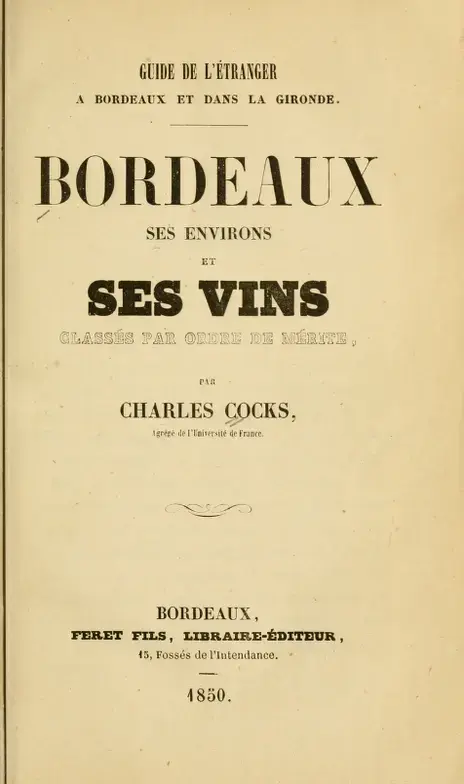
The description merits a closer look. The authors attribute structure, character and distinction to the wine, going beyond a description of the place where it was made.
The vocabulary differs from that of modern tasting. Chaud, or “warming”, for example, conveys a sense of power that can have several causes and gives no precise measure of alcohol content. The passage nevertheless offers first-hand historical evidence of the style and standing of a Canon-Fronsac wine.
The Archives of the Fontemoing Wine Merchants
Reputations also take shape in commercial records. In 1969, the historians Pierre Butel and Philippe Roudié published a study drawing in particular on the archives of the wine merchant firm of Raymond and Joseph Fontemoing in Libourne. They examined shipping registers covering 1790 to 1820 and business correspondence preserved from 1811 onwards.
These records show prices, volumes and destinations for Libournais wines. They help explain how trade contributed to the recognition of individual growths and to differences in value between estates. In other words, the reputation of a fine wine can be read in account books as much as in tasting descriptions.
6. Why Did Fronsac Lose Its Place in the Wine Hierarchy?
One Appellation, Different Approaches to Winegrowing
Fronsac’s decline cannot be explained by any sudden loss of quality in its best terroirs. One of the most interesting historical explanations concerns the coexistence of two approaches to production.
On the slopes and plateaux, some owners continued to pursue quality and reputation. In the palus, the alluvial lands near the Isle and the Dordogne, some growers focused more on producing wine in volume. These two approaches did not necessarily produce wines of the same style or commercial value.
The historian Henri Enjalbert and, more recently, research published by Féret point to how this diversity may have made it harder to define Fronsac’s identity as a wine region.
Some alluvial wines were good, and the quality of wines from the slopes also varied. There was a commercial challenge too: how do you maintain the identity of a prestigious wine when the same place name covers very different kinds of production?
Saint-Émilion and Pomerol Change the Picture
Over the nineteenth and twentieth centuries, the balance of the Right Bank changed.
Saint-Émilion developed its wine institutions, gained recognition as a region and later drew up its classification of estates.
Pomerol, long less well known, benefited from the growing reputation of certain estates in the twentieth century and became one of the most sought-after wine regions in the world. Fronsac saw no comparable commercial rise. Its reputation faded, although estates and terroirs capable of producing fine wines remained.
The history of Fronsac’s wines reminds us that market value and reputation never provide a lasting measure of a place’s intrinsic quality.
7. Fronsac and Canon-Fronsac: Two Appellations Protect a Local Identity
From the Côte de Canon to the AOC
Historical differences between terroirs were eventually reflected in official boundaries. In 1928, a court ruling established an initial boundary for the Côte de Canon. In 1932, a ruling by the Bordeaux court confirmed the right to use the name Canon alongside Fronsac for certain defined areas.

Then came the appellations of controlled origin. Côtes de Fronsac was recognised in 1937 and became Fronsac in 1976. Côtes de Canon-Fronsac was recognised in 1939, and its name was shortened to Canon-Fronsac in 1964.
Canon-Fronsac covers designated plots in the communes of Fronsac and Saint-Michel-de-Fronsac. The area includes limestone plateaux and molasse slopes. The recent alluvial soils on the valley floors are excluded.
The official boundary gave legal form to a distinction between terroirs that had long been recognised in practice and reputation. It does not mean that every bottle of Canon-Fronsac will be superior to every bottle of Fronsac. Each appellation has its own plots, growers and styles.
Limestone as a Common Thread
On the Canon-Fronsac plateau, fossil-rich limestone plays an important part in how the soils function and how the vines obtain water. On the slopes, molasse formations and clays create different growing conditions.
Depending on soil depth, water reserves and exposure, these differences can affect vine vigour, grape development and ripening. Attributing a “mineral” taste directly to the limestone would be too simple. Terroir comes from the interaction between the soil, the climate, the vines and the grower’s decisions. It cannot be reduced to a flavour contained in the rock.
8. Fronsac Today: Rediscovering a Terroir Beyond Its Former Glory
Today, many growers in Fronsac and Canon-Fronsac are working to make the diversity of their terroirs better known. Judicious harvest dates, careful extraction, ageing tailored to each wine and a better understanding of individual plots help them make more precise wines while retaining their ability to age.
At La Closerie de Fronsac, on the limestone plateau of Saint-Michel-de-Fronsac, our single-vineyard Canon Cardinal is made entirely from Merlot. The grape varieties and methods have changed since the eighteenth century. The aim is to address a question that runs through the local history: how do you express the identity of a plot in a wine people can recognise?
That was already one of the ambitions of the landowners who began to distinguish individual growths on the slopes of Canon around 1750. Their history can still be seen in the landscape, the old farms, the Romanesque churches and the vineyards overlooking the Dordogne. Fronsac has a richness that goes beyond the price of its bottles: the continuity of a place, its winegrowing skills and a history that has long been underestimated.
Conclusion: Can a Wine Region Lose Its Crown and Keep Its Terroir?
Fronsac has a distinctive place in the history of Bordeaux wines. In the eighteenth century, its finest slopes helped bring about a new idea of fine wine in the Libournais. Estate owners selected their grapes, improved their practices and built the reputations of individual growths.
In the nineteenth century, André Jullien and later Cocks and Féret still attested to the reputation of the Côte de Canon. Yet differences between growing areas, changes in trade and the rise of Saint-Émilion and Pomerol gradually pushed Fronsac down the hierarchy of reputations. Losing ground in the global wine trade did nothing to diminish the qualities of its slopes.
The limestone plateaux, the small valleys and the rivers are still there. Varieties and techniques have changed, but the potential to make wines of character remains.
Fronsac’s history reminds us that a classification, a price or a fashion can only tell part of the story of a great terroir. Recognition depends on people and on the times they live in. Its potential is revealed by the way each generation chooses to work the land.
The next article in this trilogy follows the almost opposite fortunes of Pomerol, a wine region long considered relatively discreet that became one of the world’s most prestigious in the twentieth century.
Historical and Documentary Sources
Henri Enjalbert (1983). Les Grands Vins de Saint-Émilion, Pomerol, Fronsac. Bordas-Bardi.
André Jullien (1816). Topographie de tous les vignobles connus. First edition.
Charles Cocks and Édouard Féret (1868). Les vins de Bordeaux. The passage on the Côte de Canon is reproduced in the INAO’s historical documentation.
Pierre Butel and Philippe Roudié (1969). “La production et la commercialisation des vins du Libournais au début du XIXe siècle”. Annales du Midi, 81, pp. 379–408. https://doi.org/10.3406/anami.1969.4624
Féret (2025). “Fronsac, l’oublié (à tort) de la Rive droite”, La Lettre Féret, 3 December 2025. https://feret.com/enquete-fronsac-loublie-a-tort-de-la-rive-droite/
Féret. Historical and geographical profile of Canon-Fronsac. https://feret.com/les-appellations/canon-fronsac/
INAO. Overview of the Fronsac and Canon-Fronsac appellations, their boundaries and their history. https://inao.gouv.fr/produit/canon-fronsac-20049
Guide Hachette des Vins. Profile of the Canon-Fronsac appellation and changes in grape varieties around 1900. https://www.hachette-vins.com/tout-sur-le-vin/appellations-vins/125/canon-fronsac


Comments